There is profound and persistent gender segregation in the labour market: fewer women than men working on a full-time basis, limited working hours, more precarious employment conditions, lower pay, longer career breaks, and maternity working against women punitively. This is the grim reality for women working in the EU, as recorded in the latest Equality Index of the European Institute for Gender Equality (EIGE), demonstrating the established and ongoing inequalities in participation, retention and remuneration conditions of the labour market, as well as in relation to career prospects.
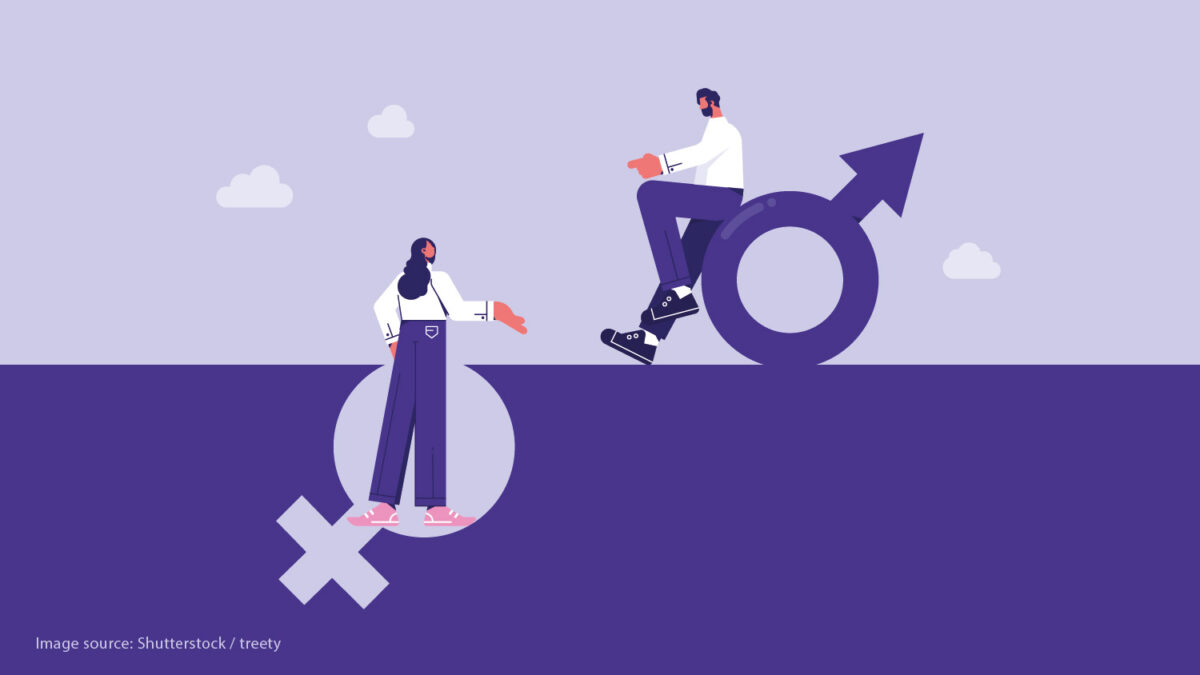
Gender segregation is a key component of employment inequality. Men dominate sectors such as technology, engineering and finance (which offer better working conditions and higher remuneration), while women are over-represented in health, education and social services (in which more difficult conditions and lower remuneration prevail). In the EU, 30.2% of women work in the latter sectors, which employ only 8.3% of men.
The Equality Index reveals that the slight increase in women’s participation in the labour market (by 1 unit) is accompanied by a reduction in the quality of work. Although minor (0.1 units), it is indicative of the emerging trend towards precarious and poorly paid employment. Although women are more involved in paid work than ever before, they remain out of the labour market longer and are far more likely to be in part-time positions than men (Figure 1). Men usually choose part-time work for education and training, while women are compelled to due to increased caregiving responsibilities for children and the elderly, primarily falling on them in the absence of equal sharing or adequate state support.

Penalising maternity
Women are forced to align their careers almost entirely with family life – something men do to a far lesser extent – often leading them to pause or quit work or to turn down higher-responsibility roles. And while they may be in part-time paid employment, this doesn’t mean they work less. Instead, it highlights the hours spent in unpaid caregiving and domestic work, still largely perceived as “women’s work” (Figure 1).
Strikingly, there was zero improvement across EU countries in the equality index’s “time use” domain, which remains the worst performing (68.5 points) among the six domains (work, money, time, knowledge, power, health).
One in three European women (and only one in ten European men) is left out of the labour market due to their responsibilities as caregivers. Although the percentage of men who now care for their children or relatives with disabilities has increased since 2007 from 12% to 30%, it is women (37%) who undertake the majority of caregiving duties overall (37%). As for couples with children, 69% of mothers shoulder the greatest part of their care, as compared with 47% of fathers. On average in the EU, 33.5% of women spend time daily on childcare and eldercare, and 63.1% on housework, compared to 24.6% and 35.7% of men, respectively.
This situation significantly affects full-time equivalent (FTE) employment, which is lower for women in every age group, employment sector, and family setting. Overall, in terms of full-time employment, 43.5% of women and 58.4% of men work in the EU, a gap of almost 15 points. In childless couples, this gap is only 5 points; in couples with children, it jumps to 26 points and to 19 points for single mothers.
Greece ranks near the bottom (4th from last) in the gender equality index for employment, with 69.4 points and a mere 0.7-point improvement since 2021 (Figure 2). However, in that same period, there was a decline (of 0.3 points) in gender segregation in the labour market and in quality of work. As for the FTE gender gap, it reached 20 points (36% for women and 56% for men), the second highest in the EU. This difference reached 33 points for couples with children.

Poorer, more vulnerable…
These unequal labour market conditions that prevail to the detriment of women are also linked to deep-rooted sexist stereotypes, such as who is “most suitable” for a job or who is traditionally the “breadwinner” and who is the “housewife”. And they have a negative impact on all aspects of women’s lives, since they perpetuate a vicious cycle of low-level and precarious employment, reduced free time (which also impacts their health), double the work load (paid and unpaid work), and lower incomes, rendering them more vulnerable to poverty and more financially dependent, ultimately undermining their autonomy.
The gap in net monthly earnings between men and women in the EU has not stopped widening since 2014, to the detriment of women. While income differences between young women and men are relatively small, the gap grows once women are in relationships or have children. Single women in the EU earn on average €312 less per month than single men. Single mothers earn €896 less than single fathers. Women in relationships earn €921 less than their partners. And for couples with children, the difference rises to €1,202, some 70% of what their partners earn. The gap is equally large (again 70%) for women with high educational attainment – who are exposed to intense vertical segregation due to their gender – and whose income is €1,438 per month lower than that of men (Figure 3).

Greece ranks fifth from last in the EU on gender equality in money (73.5 points) and is the only EU country that has reduced its performance in this area since 2010 (–1.8 points, Figure 4). The repercussions of the crisis and its gender-blind management led to a real crash in incomes, which again affected women disproportionately. Greece’s gender pay gap has increased since the beginning of the crisis, and 15 years later, it has still not been redressed, not even to 2010 levels.

It is all these structural inequalities that explain why the average working life in the EU is 34.2 years for women and 38.6 years for men, why the gender pension gap remains at 26%, and why European women are more at risk of poverty than European men.
Lack of political will
The outlook is not positive. The multiple, simultaneous crises we are facing – geopolitical, demographic, climate-related, technological – pose new challenges at a time when rights and achievements are being questioned. And obviously, as noted by EIGE DirectorCarlien Scheele, “the result of the recent European elections marks a change in the European political landscape in Europe, where the path to equality has never been so fragile.”
“The equality agenda is under attack. Committees are now part of the cultural war, there are views being expressed that deny gender-based violence, calling on women to stay at home and have more children, and other such myths,” warns Spanish socialist MEP Lina Gálvez, chairwoman of the European Parliament’s Committee on Women’s Rights and Gender Equality. “There will be a backlash and we will be attacked. And we have to fight back for gender rights. Because we cannot talk about democracy when there is violence, when there is inequality, when they want women to stay at home and be excluded from the labour market: these are democratic deficits.”
Note: The source of the Figures in the text is the Gender Equality Index 2024. You can find the full publication here: https://eige.europa.eu/publications-resources/publications/gender-equality-index-2024-sustaining-momentum-fragile-path#eige-files.